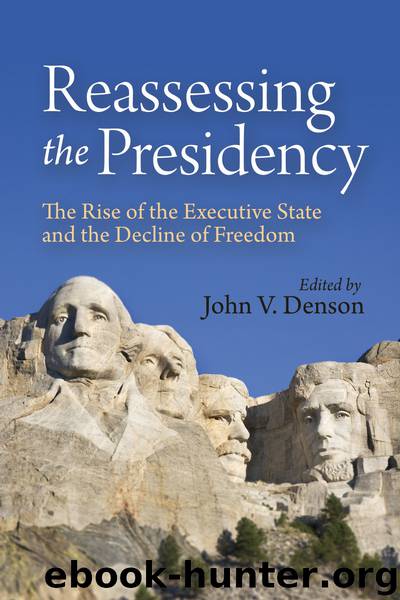
Reassessing The Presidency by John V. Denson
Author:John V. Denson
Language: eng
Format: epub
ISBN: 978-1-61016-614-0
Publisher: Ludwig von Mises Institute
Published: 2013-09-17T16:00:00+00:00
One of the significant aspects of the worldview of many of the Founding Fathers such as John Adams, but certainly evident in writings of intellectuals such as Baron de Montesquieu or Edward Gibbon, was a belief in a cyclical view of history. The fear was that the American republic would evolve in much the same cycle as had the Roman: into empire.[3]
As we survey the American presidency from the perspective of over two hundred years, it is difficult to disagree with the liberal historian, Arthur Schlesinger, Jr., that there has been an evolution toward an imperial presidency.[4] The difficulty with any evolutionary continuum or spectrum, of course, is to determine at what point a substantive transition has been made from one entity toward another—in this case, from republic to empire.[5]
In the case of classical Rome’s leadership, that transitional spectrum might be said to have evolved from tribune to consul to caesar to emperor over several centuries. In the case of the United States, it took only a couple of generations before some politicians were calling popular leaders such as President Andrew Jackson “caesarian,” although the Whigs backed off from that assessment when the party also began to select generals for presidential candidates in the 1840s.[6]
One of the first American political thinkers to discern this drift toward centralization and empire was Alexander Stephens, Abraham Lincoln’s old friend from their service together in the House of Representatives in the 1840s. Stephens, later the vice president of the Confederacy, devoted his last years to a perceptive analysis of the evolving American political system, and argued, very much like Oswald Spengler several decades later, against “empire,” and that there was “no difference between centralism and imperialism.”[7]
Whether or not one agrees with the view of a drift toward empire, several definitional matters need to be explored with respect to the phenomenon of empire. From the great imperialist surge of the Western powers into both Africa and Asia during the late nineteenth century, and given even greater emphasis by the Leninist and other neo-Marxist attempts to explain those policies, empire and imperialism have come to be almost synonymous with foreign policy. But it needs to be remembered that the other definitions of empire—centralization and the erosion of the rule of law—are in no way abrogated by the attention drawn to the former. Indeed, the two aspects of empire most often function together.
The key link between the two is the emergence of bureaucracy. Empire, whether due to an acquisition of territory abroad or an expansion and centralization of the role of government at home, is never a result of some fit of “absentmindedness”; it requires an expanding bureaucracy to administer the increasing governmental role. This inevitably leads to a massive explosion of rules and bureaucratic law, often unclear, vague, and even perhaps contradictory—what in ancient China was called legalism.[8]
In the United States, these two impulses came together at the end of the nineteenth century with the acquisition of an overseas empire and a simultaneous demand for domestic
Download
This site does not store any files on its server. We only index and link to content provided by other sites. Please contact the content providers to delete copyright contents if any and email us, we'll remove relevant links or contents immediately.
The Secret History by Donna Tartt(19025)
The Social Justice Warrior Handbook by Lisa De Pasquale(12182)
Thirteen Reasons Why by Jay Asher(8883)
This Is How You Lose Her by Junot Diaz(6869)
Weapons of Math Destruction by Cathy O'Neil(6260)
Zero to One by Peter Thiel(5782)
Beartown by Fredrik Backman(5733)
The Myth of the Strong Leader by Archie Brown(5491)
The Fire Next Time by James Baldwin(5422)
How Democracies Die by Steven Levitsky & Daniel Ziblatt(5210)
Promise Me, Dad by Joe Biden(5139)
Stone's Rules by Roger Stone(5078)
A Higher Loyalty: Truth, Lies, and Leadership by James Comey(4946)
100 Deadly Skills by Clint Emerson(4911)
Rise and Kill First by Ronen Bergman(4775)
Secrecy World by Jake Bernstein(4737)
The David Icke Guide to the Global Conspiracy (and how to end it) by David Icke(4696)
The Farm by Tom Rob Smith(4500)
The Doomsday Machine by Daniel Ellsberg(4480)
